Ebook Neuroeconomics, Second Edition: Decision Making and the BrainFrom Academic Press
From currently, finding the completed website that markets the finished books will be several, however we are the trusted site to see. Neuroeconomics, Second Edition: Decision Making And The BrainFrom Academic Press with very easy web link, very easy download, and completed book collections become our good services to obtain. You could discover as well as make use of the perks of selecting this Neuroeconomics, Second Edition: Decision Making And The BrainFrom Academic Press as every little thing you do. Life is always developing and you require some brand-new publication Neuroeconomics, Second Edition: Decision Making And The BrainFrom Academic Press to be referral consistently.
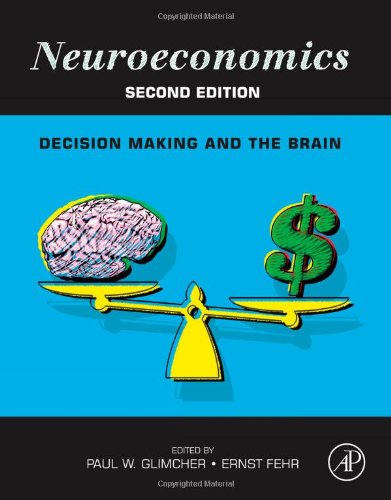
Neuroeconomics, Second Edition: Decision Making and the BrainFrom Academic Press

Ebook Neuroeconomics, Second Edition: Decision Making and the BrainFrom Academic Press
Neuroeconomics, Second Edition: Decision Making And The BrainFrom Academic Press. It is the moment to boost and revitalize your skill, understanding as well as experience consisted of some amusement for you after long period of time with monotone points. Operating in the office, visiting examine, gaining from exam and more activities could be completed as well as you have to begin brand-new points. If you feel so exhausted, why don't you try brand-new thing? A very easy point? Checking out Neuroeconomics, Second Edition: Decision Making And The BrainFrom Academic Press is just what our company offer to you will understand. As well as guide with the title Neuroeconomics, Second Edition: Decision Making And The BrainFrom Academic Press is the referral now.
Do you ever understand guide Neuroeconomics, Second Edition: Decision Making And The BrainFrom Academic Press Yeah, this is a very interesting book to review. As we told previously, reading is not sort of obligation task to do when we have to obligate. Reading ought to be a practice, an excellent behavior. By reading Neuroeconomics, Second Edition: Decision Making And The BrainFrom Academic Press, you could open the brand-new globe and also obtain the power from the world. Everything could be gained through guide Neuroeconomics, Second Edition: Decision Making And The BrainFrom Academic Press Well briefly, e-book is very powerful. As what we provide you here, this Neuroeconomics, Second Edition: Decision Making And The BrainFrom Academic Press is as one of reading publication for you.
By reviewing this book Neuroeconomics, Second Edition: Decision Making And The BrainFrom Academic Press, you will certainly get the very best thing to get. The brand-new thing that you don't have to invest over money to reach is by doing it by yourself. So, exactly what should you do now? Check out the web link page as well as download guide Neuroeconomics, Second Edition: Decision Making And The BrainFrom Academic Press You could get this Neuroeconomics, Second Edition: Decision Making And The BrainFrom Academic Press by on-line. It's so very easy, right? Nowadays, technology actually sustains you activities, this on the internet publication Neuroeconomics, Second Edition: Decision Making And The BrainFrom Academic Press, is also.
Be the first to download this publication Neuroeconomics, Second Edition: Decision Making And The BrainFrom Academic Press and allow reviewed by surface. It is extremely easy to review this publication Neuroeconomics, Second Edition: Decision Making And The BrainFrom Academic Press because you don't have to bring this printed Neuroeconomics, Second Edition: Decision Making And The BrainFrom Academic Press anywhere. Your soft documents publication could be in our kitchen appliance or computer system so you can take pleasure in checking out anywhere as well as each time if required. This is why great deals numbers of people additionally review guides Neuroeconomics, Second Edition: Decision Making And The BrainFrom Academic Press in soft fie by downloading guide. So, be just one of them that take all benefits of reviewing the publication Neuroeconomics, Second Edition: Decision Making And The BrainFrom Academic Press by on-line or on your soft data system.
In the years since it first published, Neuroeconomics: Decision Making and the Brain has become the standard reference and textbook in the burgeoning field of neuroeconomics. The second edition, a nearly complete revision of this landmark book, will set a new standard. This new edition features five sections designed to serve as both classroom-friendly introductions to each of the major subareas in neuroeconomics, and as advanced synopses of all that has been accomplished in the last two decades in this rapidly expanding academic discipline. The first of these sections provides useful introductions to the disciplines of microeconomics, the psychology of judgment and decision, computational neuroscience, and anthropology for scholars and students seeking interdisciplinary breadth. The second section provides an overview of how human and animal preferences are represented in the mammalian nervous systems. Chapters on risk, time preferences, social preferences, emotion, pharmacology, and common neural currencies―each written by leading experts―lay out the foundations of neuroeconomic thought. The third section contains both overview and in-depth chapters on the fundamentals of reinforcement learning, value learning, and value representation. The fourth section, “The Neural Mechanisms for Choice,” integrates what is known about the decision-making architecture into state-of-the-art models of how we make choices. The final section embeds these mechanisms in a larger social context, showing how these mechanisms function during social decision-making in both humans and animals. The book provides a historically rich exposition in each of its chapters and emphasizes both the accomplishments and the controversies in the field. A clear explanatory style and a single expository voice characterize all chapters, making core issues in economics, psychology, and neuroscience accessible to scholars from all disciplines. The volume is essential reading for anyone interested in neuroeconomics in particular or decision making in general.
- Editors and contributing authors are among the acknowledged experts and founders in the field, making this the authoritative reference for neuroeconomics
- Suitable as an advanced undergraduate or graduate textbook as well as a thorough reference for active researchers
- Introductory chapters on economics, psychology, neuroscience, and anthropology provide students and scholars from any discipline with the keys to understanding this interdisciplinary field
- Detailed chapters on subjects that include reinforcement learning, risk, inter-temporal choice, drift-diffusion models, game theory, and prospect theory make this an invaluable reference
- Published in association with the Society for Neuroeconomics―www.neuroeconomics.org
- Full-color presentation throughout with numerous carefully selected illustrations to highlight key concepts
- Sales Rank: #435702 in Books
- Published on: 2013-10-11
- Original language: English
- Number of items: 1
- Dimensions: 10.87" h x 8.50" w x 1.00" l, 4.27 pounds
- Binding: Hardcover
- 560 pages
Review
"This fully revised, second edition comes five years after the first and reflects the tremendous growth in the field of neurobiology of decision making…The text, uniformly well written and accessible, does not shy away from controversies in the research. This is an excellent text for either a graduate course or a very advanced undergraduate course on the subject." Summing Up: Recommended.--CHOICE Reviews Online, June 2014 "This book describes neuroeconomics, a combination of neuroscience and behavioral economics, with the goal of understanding how economic policies influence motivation on a neuropsychological level and, ultimately, behavior…This is an excellent book…It should be in the libraries of students and professionals interested in neuroeconomics."Rating: 4 Stars--Doody.com, April 4, 2014
Reviews for the First Edition: “Neuroeconomics is a timely collection of papers by leading researchers from both sides of the border between economics and neuroscience…The book should be of interest to anyone who has ever wondered about the mechanics of how decisions are made in the brain, and what it means about human nature.”--VINCE CRAWFORD, DISTINGUISHED PROFESSOR OF ECONOMICS, UNIVERSITY OF CALIFORNIA, SAN DIEGO, USA “Economists pride themselves on rigorous parsimony. By taking the neural correlates of behavior into account, potentially explanatory variables explode. This book shows when digging deeper nonetheless pays for economics, and how to do it well.”--CHRISTOPH ENGEL, EXECUTIVE DIRECTOR, MAX PLANCK INSTITUTE FOR RESEARCH ON COLLECTIVE GOODS, BONN, GERMANY “For those onlookers who can’t quite accept that neuroscience may provide insight into how we decide what course of action to follow, the contributors to this comprehensive volume offer some very compelling, and very serious experimental and theoretical insights. Highly recommended, and enormously provocative.”--FLOYD BLOOM, PROFESSOR EMERITUS, DEPARTMENT OF NEUROPHARMACOLOGY, THE SCRIPPS RESEARCH INSTITUTE, LA JOLLA, USA
From the Back Cover
In the years since it first published, Neuroeconomics: Decision Making and the Brain has become the
standard reference and textbook in the burgeoning field of neuroeconomics. The second edition, a nearly
complete revision of this landmark book, will set a new standard. This new edition features five sections
designed to serve as both classroom-friendly introductions to each of the major subareas in neuroeconomics,
and as advanced synopses of all that has been accomplished in the last two decades in this rapidly
expanding academic discipline. The first of these sections provides useful introductions to the disciplines of
microeconomics, the psychology of judgment and decision, computational neuroscience, and anthropology
for scholars and students seeking interdisciplinary breadth. The second section provides an overview of
how human and animal preferences are represented in the mammalian nervous systems. Chapters on risk,
time preferences, social preferences, emotion, pharmacology, and common neural currencies―each written
by leading experts―lay out the foundations of neuroeconomic thought. The third section contains both
overview and in-depth chapters on the fundamentals of reinforcement learning, value learning, and value
representation. The fourth section, “The Neural Mechanisms for Choice,” integrates what is known about the
decision-making architecture into state-of-the-art models of how we make choices. The final section embeds
these mechanisms in a larger social context, showing how these mechanisms function during social decisionmaking
in both humans and animals. The book provides a historically rich exposition in each of its chapters
and emphasizes both the accomplishments and the controversies in the field. A clear explanatory style
and a single expository voice characterize all chapters, making core issues in economics, psychology, and
neuroscience accessible to scholars from all disciplines. The volume is essential reading for anyone interested
in neuroeconomics in particular or decision making in general.
About the Author
Paul W. Glimcher, Julius Silver Professor of Neural Science, Economics and Psychology at New York University. Director, Center for Neuroeconomics, NYU. A.B. - Princeton University, Magna cum Laude. Ph.D. -University of Pennsylvania, Neuroscience. Fellow of the American Association for the Advancement of Science, The Association for Psychological Science and the McKnight, Whitehall, Klingenstein and McDonnell Foundations. Investigator of the National Eye Institute, The National Institute of Mental Health, the National Institute of Neurological Disorders and Stroke and the National Institute on Aging. Founding President of the Society for Neuroeconomics. Winner of the Margaret and Herman Sokol Faculty Award in the Sciences, 2003. Winner of NYU’s Distinguished (Lifetime Accomplishment) Teaching Award, 2006. Member of the Dana Alliance for Brain Initiatives. Publications in Nature, Science, Neuron, Journal of Neurophysiology, American Economic Review, Quarterly Journal of Economics, Games and Economic Behavior, Vision Research, Experimental Brain Research, MIT Encyclopedia of Cognitive Science, International Encyclopedia of Social and Behavioral Science and numerous edited volumes. He is the author of: Decisions, Uncertainty and, the Brain: The Science of Neuroeconomics, 2003 from MIT Press. Winner of the American Association of Publishers Medical Sciences Book of the Year, 2003. Neuroeconomics. Decision Making and the Brain, 2009 from Academic Press. Winner of the American Association of Publishers Economics and Social Sciences Book of the Year Awards, 2009. Foundations of Neuroeconomic Analysis, 2011 from Oxford University Press. Neuroeconomics. Decision Making and the Brain 2nd ed. 2013. Professor Glimcher’s work has been covered by the popular press in the Wall Street Journal, Time, Newsweek, The Los Angeles Times, Money Magazine, New Scientist, and on National Public Radio, The BBC, Le Monde, Die Welt, Frankfurter Allgemeine, La Vanguardia, Fox News, and NOVA amongst others.
http://www.neuroeconomics.nyu.edu
http://www.cns.nyu.edu/~glimcher
Most helpful customer reviews
13 of 13 people found the following review helpful.
THE most up to date book on the fast-emerging field of neuroeconomics.
By B. Johnson
I bought this book through amazon.com on June 28, 2014, about 5 months ago [for $58.39]. It is everything its team of editors, the 43 authors of its 27 articles, and its multiple publishers say it is.
The book’s greatest strengths.
It is THE definitive, THE most up to date book on the fast-emerging field of neuroeconomics.
It is meaty. It contains a large number of excellent illustrations that expand the text surrounding it. They are full color, very detailed, summarized, and are annotated as to source. Very strong here.
After every chapter there is an exhaustive list of sources and references that is priceless for other researchers and students.
Since the field of neuroeconomics is so new, circa 1990 or so, it does not qualify for “discipline” status yet. These bibliographical lists contain many of the seminal sources for the primogenitors of neuroeconomics, economics, psychology, and biology. That list is not exhaustive, but it does help you understand the biases and gaps that guided the authors’ research and influenced their point of view. Very telling.
It is hefty in wright and content. It may cost the least per pound of any book on amazon.com. If you get through it completely, then you can then buy the other 100 or so books this one subsumes.
Now the greatest weaknesses. However, you should be forewarned about a few attributes that you have to adjust to get full value from this book.
I bought it to read it for a Coursera course I was taking. I quickly discovered it is not the type of book you “read” from beginning to end or even ever finish reading. It is a massive, dense, engaging read. I barely go through the introductory chapter on the History of Neuroeconomics and the 7 chapters in Part 1, The Fundamental Tools of Neuroeconomics -- the first 125 pages or so-- before the 8-week class was over. However, I learned much more from the book than from the course and it hooked me on wanting to read more.
Everyone in the list in the first paragraph is overly eager to point out repeatedly – and tellingly -- that the field of neuroeconomics is relatively new and rapidly growing confederation of researchers from the long established disciplines of economics, psychology, and biology, with a touch of anthropology thrown in.
This book’s greatest weakness is that it reads like an encyclopedia. Its greatest strength is that it IS an encyclopedia. The editors state that their goal was to produce a textbook. They overshot that moon. In order to be a textbook, it needs some learning tools, like review questions, suggested exercises, gedankenexperiments, etc.
This “textbook” relies solely on its organization as its major pedagogical tool. It is organized into 5 sections, each with 3 to 7 chapters. There is an order to this thread, but you only perceive it after you have read at least half the book. I found myself skipping around from chapter to chapter to pursue specific topics that interested me.
The Index was not as helpful as I needed it to be to facilitate my tracing the topics I pursued across the 27 chapters where the information I sought was buried. This is one area that could be greatly improved.
One wild tangent here. Has anyone noticed how useless most indices are these days? I think they are compiled by computers that search only for keywords that are incapable of spotting key ideas, key references, and themes in a complete sentence that provide the substance of most learning. I found myself writing in over 100 key ideas missing from the index. Pardon this rant on the publishing industry.
It is laden with scientific elitism, self-promotion, condescension, and “attitude,” terms of art, jargon, etc. You have to can get past the “academic attitude” that detracts from the simple grace of scholarship.
NET: If you are interested in neuroeconomics – for any reason – this is THE source you should “read” first, or have it handy for reference, or display it as a talisman or to anyone you encounter that you want to impress. Don’t’ worry about anyone calling your bluff, most will not be able to lift it.
2 of 2 people found the following review helpful.
Outstanding sourcebook
By Doc Bobster
This is an outstanding sourcebook. Excellent set of chapter authors, and really well thought out division of chapter topics that complement and reinforce each other. Very up-to-date (except that in this field, by the time you are in print you are inevitably out-of-date already). I particularly liked that there was very little cheerleading about "how important this approach will be" -- just a focus on the developing science.
12 of 13 people found the following review helpful.
Excellent info but filled with typos
By Bob Siegel
This could have been an excellent text book on this possibly growing subject but the vast number of typos, many that have caused me confusion as someone new to this subject, make the otherwise excellent info (dense and challenging) very difficult to understand. Did they mean dlFPC or dlPFC? Probably the later, but why did I need to spend time trying to figure this out.
Glimcher is far too good for this work.
Neuroeconomics, Second Edition: Decision Making and the BrainFrom Academic Press PDF
Neuroeconomics, Second Edition: Decision Making and the BrainFrom Academic Press EPub
Neuroeconomics, Second Edition: Decision Making and the BrainFrom Academic Press Doc
Neuroeconomics, Second Edition: Decision Making and the BrainFrom Academic Press iBooks
Neuroeconomics, Second Edition: Decision Making and the BrainFrom Academic Press rtf
Neuroeconomics, Second Edition: Decision Making and the BrainFrom Academic Press Mobipocket
Neuroeconomics, Second Edition: Decision Making and the BrainFrom Academic Press Kindle

Tidak ada komentar:
Posting Komentar